"Take Five" with Shari Eberts
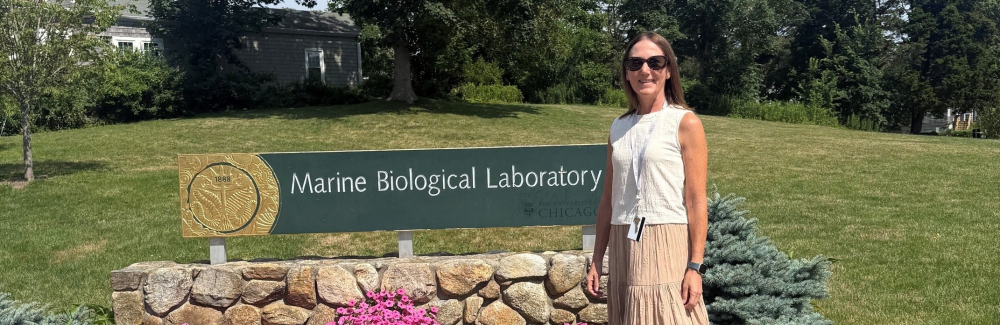
“Take Five” is an occasional feature in which we ask members of the MBL community five questions about their careers, inspirations, and passions. Shari Eberts—hearing health advocate, author, and speaker—recently visited the Marine Biological Laboratory to speak with students in the 2026 Biology of Hearing and Balance Course. While she was on campus, the MBL Communications team took the opportunity to ask her five questions of our own.
1. What message did you most hope the students take away from your lecture?
I wanted the students to remember that the people they're trying to help are real, and that hearing loss is about far more than sound. Behind every damaged hair cell is a person whose relationships, career, confidence, and identity have been affected by hearing loss. I hoped that they would leave the meeting not only with increased empathy for the lived experience of hearing loss but also feeling energized and inspired by the purpose of their work. The research they’re doing will one day help people with hearing loss stay better connected to the people and activities they love most. Science changes lives, especially when it partners with the people it's meant to serve.
2. What did you learn from your time at MBL?
I loved seeing both the breadth and depth of the research underway as well as the remarkable collaboration across institutions and related fields of study. It reminded me that every future breakthrough begins with curious people asking thoughtful questions. I was also struck by how eager the students were to understand the lived experience of hearing loss. Several shared stories of their own hearing loss, or that of their family members. They wanted to better understand what daily life with hearing loss is really like and how they could better support the people they know with hearing loss.
3. How have your different roles shaped the way you think about improving the lives of people with hearing loss?
Each role has reached a different audience, but they all help reinforce the same lesson: life with hearing loss can be better when we learn to live more skillfully with it. This is the premise of our book Hear & Beyond: Live Skillfully with Hearing Loss. In it, my co-author Gael Hannan and I outline a three-legged stool of skills necessary for living well with hearing loss. Technology—hearing aids and cochlear implants—is essential, but so are the MindShifts and Communication Behaviors that help people use that technology successfully. Blogging, speaking, and filmmaking have helped me share this important message across a variety of media, which makes it more interesting and accessible for broader groups of people. People with hearing loss need to be active partners in their own care, and I hope my work helps make that happen.
4. Why is it so valuable for scientists and clinicians to hear directly from people living with hearing loss?
People living with hearing loss experience things that can't always be measured in a lab or captured on a test result. We know which challenges have the biggest impact on daily life, which solutions are truly practical, and where the greatest unmet needs remain. Listening to people with hearing loss can help researchers ask better research questions, develop more impactful treatments, and ultimately improve outcomes. It also works both ways. Spending time with hearing researchers reminds me just how much passion and innovation are driving this field.
5. Looking ahead, what gives you the most hope?
On the research side, we're making real progress toward a better understanding of how hearing works—it’s complicated!—and using that knowledge to develop new treatments, and ultimately, cures. The extraordinary science training happening at places like MBL is a big part of that. Exciting communication technologies like machine learning in hearing aids and public listening systems like Auracast also give me hope that one day, communication access for people with hearing loss will be more widespread. Just as encouraging is the growing public awareness of hearing health as an important part of overall health, which has helped bring hearing loss into the mainstream conversation. More people are talking openly about hearing loss, advocating for themselves, and expecting accessibility instead of accepting isolation. All of this points in the same direction: a future where hearing loss no longer costs people the conversations, relationships, and activities they love most.