Inspired in Two Weeks: How Short Courses Lead Students to MBL Embryology
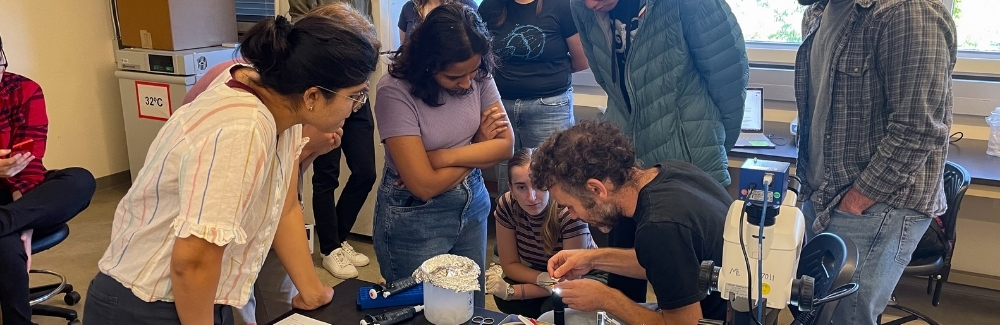
A two-week introduction to intensive, lab-focused, developmental biology training was all it took for Varsha Tamilkumar and Juan Pablo Venegas Martínez to know they wanted more. This summer, both arrived in Woods Hole for the Marine Biological Laboratory's Advanced Research Training Course (ARTC) in Embryology. The ARTC, established in 1893, is a six-week intensive in developmental biology. Its rigorous education attracts researchers from across the globe, and its rich history of field pioneers and Nobel Laureates draws students to join its legacy.
Some researchers are introduced to the MBL’s legacy in embryology through two-week courses inspired by the ARTC. For some students, including Tamilkumar and Venegas, those two weeks were enough to inspire them to pursue the full summer intensive.
Tamilkumar first set her sights on MBL Embryology while pursuing her Ph.D. at the National Centre for Biological Sciences in Bengaluru, India. What appealed to her most was the course's intensive nature. “I love working,” she said. “And I just wanted to experience being in a world where all you have to do are experiments and imaging…. That is something that cannot happen outside of this course.”
Though she initially applied to the longer course, she was not immediately accepted. However, in 2024, her efforts landed her in the two-week Comparative Developmental Biology (CDB) course in Woods Hole. The experience exposed her to the MBL’s distinctive approach to teaching Embryology and reaffirmed her interest in the full ARTC.
In 2025, Venegas of the University of Chile attended the Practical Course in Developmental Biology in Quintay, Chile, organized by Roberto Mayor and colleagues. Roberto is an alum of the Embryology ARTC, and took inspiration from that experience to establish the two-week course in Chile. The course aims to expand opportunities for Latin American students to gain hands-on training in developmental biology, a field that has grown rapidly throughout the region. According to Venegas, many who attend the Quintay course also dream of coming to Woods Hole, some viewing the practical as a “trampoline” to get there.
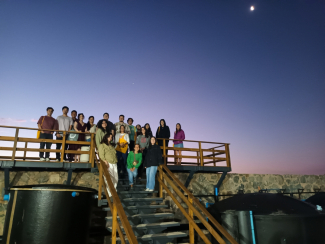
For Venegas, that goal became a reality. At the end of the course, he was one of two students awarded the Quintay Prize, which includes a fellowship to attend MBL's ARTC in Embryology.
Now that Tamilkumar and Venegas experienced the full ARTC, they said the course did not disappoint.
For Venegas, being at the Woods Hole campus came with some unique perks: exposure to a broader range of research organisms, and more time to pursue novel experimental approaches. While the Quintay practical focuses on widely used laboratory models, such as frogs and zebrafish, ARTC students work with organisms such as echinoderms, spiralians, cnidarians, and ctenophores, according to Athula Wikramanayake, one of Embryology’s 2026 course directors. This is important, he said, because “the range of evolutionary questions you can ask with these other organisms is much broader than what you can do with the established model systems.”
Tamilkumar did get a great preview of these unique non-standard research organisms from the CDB course, due to its Woods Hole location. That access makes the CDB course a strong alternative for researchers who can’t commit to six weeks: they get exposure to a breadth of new research organisms in much less time, and also focused time for independent projects. For those like Tamilkumar who want more, though, the ARTC allows for even more time to explore these models in depth.
Something else Tamilkumar and Venegas enjoyed this summer was spending more time with leading researchers—not only via lectures, which are frequent in the ARTC, but through conversation as well. When speaking with them, “you get new ideas for your hypothesis,” said Tamilkumar. “So then, you get a better and fresher perspective on how to approach your quest.” In Venegas’s experience, these discussions even happened over lunch. Wikramanayake noted that these connections often last beyond the course and become instrumental in alumni’s future.
Most of all, Tamilkumar and Venegas appreciated the experimental freedom the MBL courses offered them. “It’s like Pandora’s box,” said Tamilkumar. “You have everything and you can do whatever you want. So, your creativity is the limit.”
For Tamilkumar and Venegas, two weeks were enough to inspire them to both take the full Embryology course. But their stories also highlight the value of MBL's shorter offerings, which give scientists an immersive introduction to new techniques, organisms, and collaborations in a format that fits many stages of a research career. Whether students spend two weeks or six, the experience can shape the questions they ask—and where those questions lead next.
For researchers interested in attending either two-week course, applications are now open for both. Apply by July 28 for the CDB course in October, and by July 30 for the Quintay practical in January!