Chance Favors the Curious: How Serendipity Drives Scientific Discovery

“Serendipity... You will understand it better by the derivation than by the definition. I once read a silly fairy tale, called 'The Three Princes of Serendip': as their Highnesses traveled, they were always making discoveries, by accidents and sagacity, of things which they were not in quest of.” — Horace Walpole, 1754
Sidney Tamm is no stranger to serendipity.
The cell biologist and MBL Whitman scientist has significantly contributed to our understanding of the cell—and for many of his discoveries, lucky accidents were on his side. Tamm recently published a paper about taking advantage of his good fortune in the Journal of Trial and Error, and how chance helped him redefine what we know about cells.
Tamm’s serendipity began in the 1970s with a termite-infested grapefruit tree. His colleague at Indiana University had removed the tree from his mother’s yard and donated its logs to Tamm, who had been researching protozoa in termite hindguts. Thinking little of it, Tamm let an undergrad examine the single-celled microbes. But then, the student reported something that struck him as odd: a protozoan’s head was rotating continuously in the opposite direction of its body. This, Tamm realized, would only be possible if its cell membrane was fluid.
A closer look confirmed Tamm’s suspicion, but the idea of a fluid cell membrane contradicted what almost everyone believed at the time. “People were very skeptical,” said Tamm. No one had ever visualized a fluid membrane before, though it had been proposed earlier on. While it took time to be accepted, Tamm’s discovery ended up being so foundational that it ended up in biology textbooks.
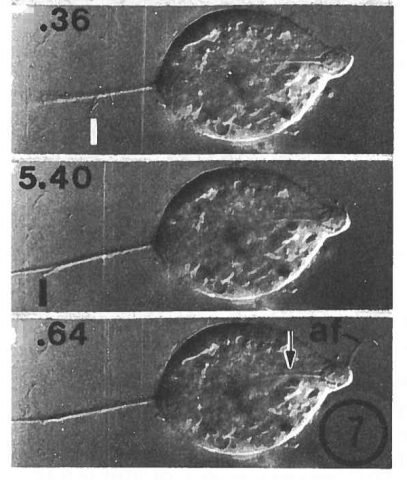
Tamm continued on his serendipitous streak studying termite protozoa. He found that their rotary movement wasn’t generated by their flagella, which are hair-like motility structures, but actually by a long rod through its length called an axostyle. Never before had a scientist seen a rotary motor in eukaryotic cells.
The surprises didn’t stop there. Tamm then discovered that the protozoa could move without flagella or axostyles. Thousands of flagellated bacteria living in pockets of the cell’s surface propelled the protozoan on their own, flicking their ‘tails’ in sync. This unique discovery went on to deepen our understanding of symbiosis between prokaryotic and eukaryotic cells.
In total, that’s three major discoveries about cells, all thanks to one termite infestation.
Tamm’s run-ins with chance have continued throughout his scientific career at the MBL, where he has been a “long-term fixture,” according to MBL Librarian Samantha Porter. One of his more recent serendipitous discoveries was that some ctenophores have transient anuses.
But Tamm doesn’t think happy accidents come from thin air. Throughout his career, he’s found that serendipitous discoveries come to scientists who are “sagacious”: experienced and open-minded enough to recognize the unexpected and seize the opportunities that accidentally arise.
In other words, serendipity is not just about luck, but about knowing what to do with it. That ability has shaped Tamm’s legacy of seeing what few could’ve dared to imagine.